Cambelt replacement quoted by engine, not by guesswork

A cambelt is a job where preparation matters as much as spanner work. We start from your engine code and the manufacturer's current interval, because a good number of intervals have been revised since the cars were built and the figure printed in an old handbook can be wrong. The quote covers the kit, the water pump where the belt drives it, coolant and any single-use bolts, so nothing is added halfway through. Prices start from £475 and vary a great deal between engines. Most cars are with us for the day.

  • ★★★★★ 4.9/5 from 193 Google reviews
  • From £475 · 3–6 hours
  • Mon–Fri 8am–8pm · Sat 8am–5pm
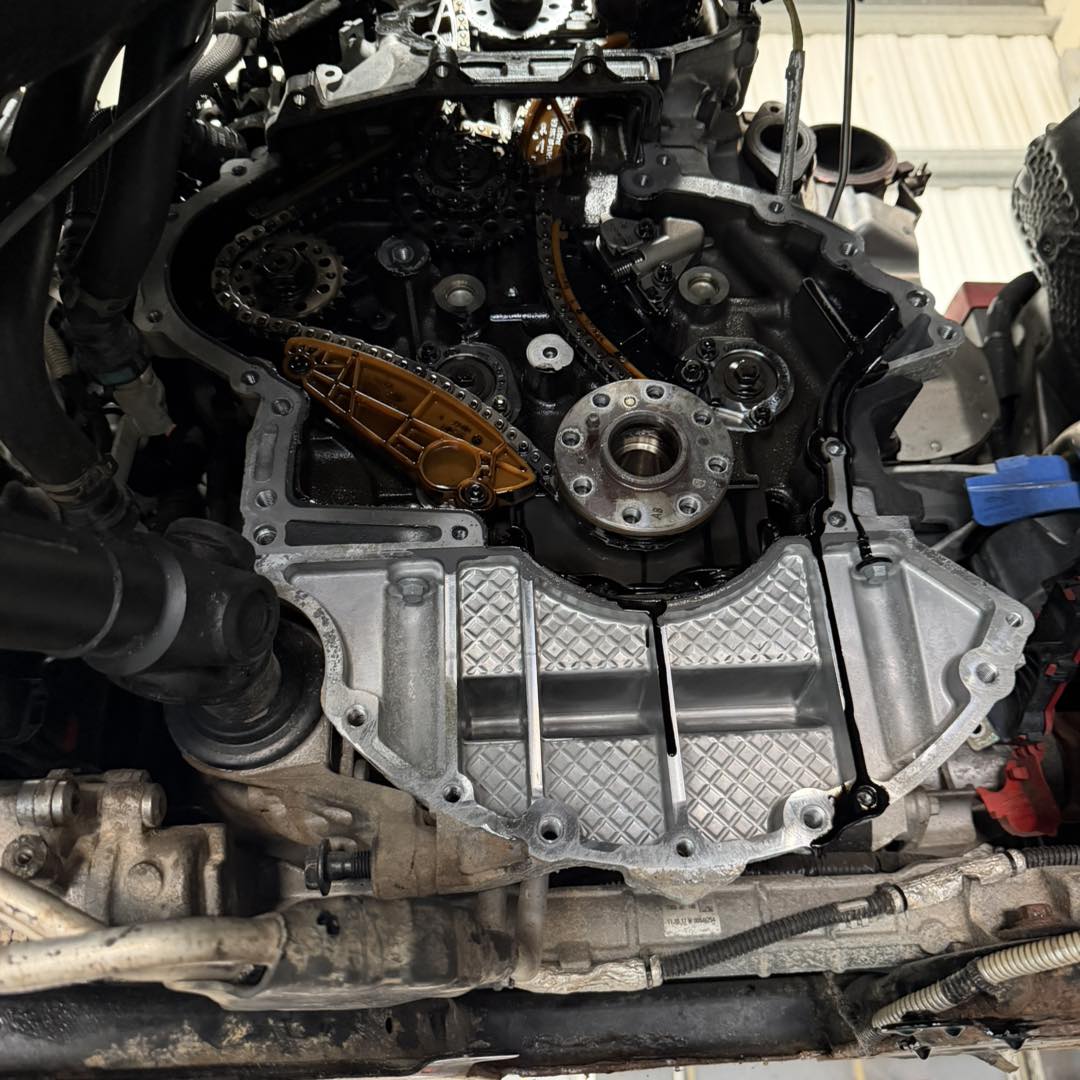
Engine timing components exposed during repair at KITH Cars Garage & Bodyworks, Hackbridge
From £475Written quote before we start
3–6 hoursTypical time in the workshop
3 monthsWorkmanship warranty
17 areasCollection across South London

Interval checked, not assumed

We look up the current manufacturer figure for your engine code, including any revision issued since the car was built, rather than working from the book in the glovebox.

Tools specific to your engine

Camshafts and crankshaft are held by the locking tools made for your engine, so the new belt goes on in exactly the position the manufacturer intended it to.

Leaks dealt with together

A weeping seal or pump that would ruin a fresh belt is found while everything is already apart, and quoted to you before any more work goes ahead.

Awkward engines taken on

V6 and tightly packaged engines take longer and some workshops would rather not touch them. We quote them honestly on the time they need instead of turning the work away.

How we handle cambelt replacement at Hackbridge

The correct locking tools are not optional on this job. Every engine has its own set, and universal kits claiming to fit everything are the reason some belts end up a tooth out. We set the engine to its timing position, lock the camshafts and crankshaft with the tools made for that engine, and check the marks agree before anything is loosened, because an engine already out of time tells us something important before the belt is touched. Access varies enormously: many transverse engines need supporting and the mount removing, and some need the wheel and wing liner out of the way.

With the covers off, the old belt is worth reading. Oil or coolant on it means a seal or pump that must be sorted now, or the new belt goes the same way. Polished teeth, cracking at the tooth root, or a belt that has been tracking slightly off its pulleys all get looked at and shown to you. Tensioners and idlers are spun and listened to before they go in the bin, so we can tell you what state they had reached. Single-use bolts, crankshaft pulley bolts especially, are replaced rather than reused, because a stretch bolt torqued twice will not hold the same clamping force.

If a belt has already snapped, we will not simply fit a new one and hope. A compression test, and a borescope through the plug holes where possible, tells us whether the valves have survived, and it is better to know before you have paid for a kit. We will not fit a belt on its own and leave the original tensioner and idlers in place. And we will not guess an interval from a model name when engines within one model take different figures. The price is agreed in writing from your engine code, with the pump listed separately so you can see what you are paying for.

Cambelt Replacement: what’s involved

The cambelt is a toothed rubber belt that keeps the crankshaft and camshafts turning in exact step, so the valves open and close at the right moment relative to the pistons. On many engines the same belt also drives the water pump. The belt is guided by a tensioner and idler pulleys, which have bearings that wear at the same rate as the belt.

Most modern engines are interference designs, meaning the valves and pistons share the same space at different times. If the belt snaps or jumps a tooth, the pistons hit the open valves. The usual result is bent valves and often damaged pistons or a damaged cylinder head, and sometimes the engine is not worth repairing. A cambelt rarely gives any warning before it fails, which is why it is replaced by age and mileage rather than when it goes wrong.

Signs your cambelt needs attention

Due or overdue by age or mileage

The most important sign is on paper. If the interval has passed on either time or miles, the belt is due, even if the car runs perfectly.

No record of a change

If you have bought a used car with no invoice showing a cambelt change, assume it has not been done and have it replaced.

Oil or coolant on the belt

Leaking camshaft or crankshaft seals, or a weeping water pump, soften the rubber and can make the belt slip or strip teeth. The leak needs fixing at the same time.

Whining, ticking or rumbling from the belt end

A worn tensioner or idler bearing can whine or rumble from the timing end of the engine. Bearing failure can take the belt with it.

Coolant loss near the water pump

On engines with a belt-driven water pump, a crusty coolant trail or damp patch below the pump means its seal is failing.

Cracks, glazing or fraying

Visible cracking on the back of the belt, shiny glazed teeth or frayed edges seen through an inspection cover mean it is overdue.

Engine will not start after a noise

If the engine turns over faster than normal but will not fire after a slap or clatter, the belt may have broken. Do not keep cranking; have it recovered.

When should a cambelt be changed?

Every manufacturer sets its own interval in both miles and years, and the belt must be changed at whichever comes first. The rubber ages even when the car sits still, so a low-mileage car can be due on time alone. Intervals vary widely between engines, and some have been revised by the manufacturer since the car was new. We look up the current figure for your exact engine code. If your car's history is unknown, the safest approach is to change it now and start the clock again.

  • Typical intervals: 40,000–100,000+ miles or 4–10 years, whichever comes first, depending on engine
  • Change on age alone if the car does low mileage
  • Change straight away if there is no proof it has been done on a used car
  • Replace the water pump at the same time if it is driven by the belt
  • Change early if the belt has been contaminated by oil or coolant

How we replace a cambelt

  1. Confirm the interval and quoteWe check your engine code, the current manufacturer interval and your service history, then give you a written quote covering the belt, tensioner, idlers and water pump where applicable.
  2. Lock the engine timingThe engine is set to its timing position and locked with the correct engine-specific timing tools so the camshafts and crankshaft cannot move.
  3. Strip to the beltEngine covers, the auxiliary drive belt and pulleys are removed, and on many transverse engines the engine mount is removed with the engine supported.
  4. Replace belt, tensioner and idlersThe old belt, tensioner and idler pulleys come off. We check the camshaft and crankshaft seals for leaks before fitting the new parts.
  5. Replace the water pumpWhere the pump is belt-driven, it is replaced with a new gasket or seal while everything is accessible.
  6. Tension and verify timingThe new belt is tensioned to specification, the locking tools removed and the engine turned by hand through two full revolutions to confirm the timing marks line up again.
  7. Refill and bleed coolantThe cooling system is refilled with the correct coolant and bled of air.
  8. Road test and recordWe run the engine to temperature, check for leaks and noise, road test, then record the date and mileage on your invoice and a label in the engine bay.

Cambelt parts we fit

We fit complete OE or OE-equivalent timing kits from suppliers such as Gates, Dayco, ContiTech, INA and SKF, who make belts and tensioners for car manufacturers. A kit includes the belt, tensioner and idler pulleys so every wearing part starts fresh. Where the water pump is driven by the belt we fit a new pump from the same quality of supplier, and refill with coolant of the correct type for your engine.

  • Timing belt
  • Tensioner and idler pulleys
  • Water pump and seal where belt-driven
  • Coolant to manufacturer specification
  • Camshaft or crankshaft seals if they are leaking

How long it takes

3–6 hours

Most engines take 3–5 hours. Some V6 and tightly packaged engines take longer, so we often ask you to drop the car off in the morning and collect it the same afternoon or the next day.

What’s included

  • Confirmation of the correct interval for your engine
  • Belt, tensioner and idler pulleys
  • Water pump replacement where belt-driven
  • Engine-specific timing tools and timing verification
  • Coolant refill and bleed, leak check and road test
  • Invoice and engine bay label showing date and mileage

What people get wrong about cambelt replacement

The belt looks fine

Belts fail from the inside out. The rubber hardens and the tooth roots crack where nobody can see them, so a belt that looks perfect through an inspection cover can be days away from letting go.

A stamped book proves it

A stamp is not an invoice. Ask for the receipt showing part numbers, date and mileage, and if nobody can produce one, treat the belt as though it has never been changed.

Only the mileage counts

The interval is mileage or years, whichever arrives first, and rubber ages on the driveway just as it does on the road. Low-mileage cars are the ones most often caught out by it.

A chain means nothing to do

Chains last longer but they are not maintenance free. They depend on oil pressure and clean oil, and a stretched chain or a collapsed tensioner does the same damage as a snapped belt.

Price your cambelt replacement now

Enter your reg and we’ll look up your car, then price the job from our own labour rates and the book time for your model. Nothing is booked until you say so, and the written quote comes before any work.

  • Free, about 30 seconds, no sign-up
  • Parts, labour and VAT included
  • 3-month workmanship warranty
  • Collection and delivery across South London
“It’s rare to find a garage you can truly trust. Fair price, brilliant customer service.”Thinushan K. · ★★★★★ Google

Prefer to talk? Call 020 4629 9469 or WhatsApp us.

Loading instant quote…

Cambelt Replacement: your questions answered

Why do cambelt quotes vary so much between cars?

Access, mostly. An engine where the belt sits behind a cover and a mount is a few hours. A tightly packaged V6, or one that needs the front of the car moving to reach it, is most of a day. Kit prices differ too, and whether the pump is belt-driven changes both parts and labour, which is why we price from your engine code.

My belt has already broken. Is it worth repairing?

That depends on what the engine has done to itself, and it is worth spending a little to find out. A compression test tells us whether valves are bent. On a car with a sound body and a decent history, a cylinder head repair can still be worthwhile. On a tired car it often is not, and we will say so plainly.

Is it worth doing on an older car?

If the car is otherwise sound and you intend to keep it, yes, because a belt change is small next to an engine. If it has corrosion, a failing gearbox or an MOT full of advisories, the belt may be good money after bad. Bring it in and we will look over the whole car before you commit.

What is covered if something goes wrong afterwards?

Our side of it is covered for three months; the belt kit is covered by the firm that made it. Hold on to the invoice, because both rely on it as proof. If the engine develops a noise or a leak in the first few hundred miles, bring it straight back rather than waiting for the next service.

How do I know if my car has a cambelt or a timing chain?

It depends on the engine, and some makers use both across their range. Tell us your registration and we will confirm what your engine has and what its interval is.

Why replace the water pump if it is not leaking?

When the pump is driven by the cambelt, a pump bearing or seal failure can wreck the new belt. Most of the labour is shared, so replacing the pump at the same time costs far less than doing it separately later.

My car has a wet belt. Is that different?

Some engines, including Ford's 1.0 EcoBoost and the 1.2 PureTech used by Peugeot, Citroën and Vauxhall, run the belt inside the engine in oil. These belts can degrade early if the wrong oil is used or changes are missed, and debris can block the oil pick-up. Manufacturers have revised some of these intervals, so we check the current guidance and quote these jobs individually.

Does a cambelt change affect my service history?

Yes, positively. It is one of the first things buyers and dealers check. We record the date and mileage on your invoice so you have proof it has been done.

Can I just replace the belt and not the tensioner?

We do not recommend it. The tensioner and idlers have bearings that have done the same miles as the belt, and a pulley failure can destroy the new belt. Belt manufacturers supply kits for this reason.

Book your cambelt replacement with KITH Cars

Quick booking below. Or call 020 4629 9469.

Written quote before any work begins
No surprises on collection.
3-month workmanship warranty
On every repair.
Pick-up & drop-off across South London
Croydon, Sutton, Mitcham & more.
Mon–Fri 8am–8pm · Sat 8am–5pm
Call 020 4629 9469WhatsApp Us
1Service
2Details
3Your Info
4Booking

What do you need?

Choose a service to get started.

Your contact details

So we can confirm your booking and send your quote.

Choose a preferred date & time

We'll confirm availability when we get back to you.

Loading…
MonTueWedThuFriSatSun

We reply within 30 minutes  ·  Prefer to call? 020 4629 9469

Booking request sent!

We've received your enquiry and will confirm your preferred slot within 30 minutes. Check your inbox — or we'll call you shortly.

020 4629 9469

What our customers say

Rated 4.9 ★ on Google — 193+ reviews

★★★★★

“BMW 1 Series needed a new timing chain and clutch. Fair price, courtesy car offered. Stands out from most garages.”

Aaron Konadu
★★★★★

“Professional, no upselling, everything explained clearly. Work completed same day and car runs perfectly.”

Ziaur Rahman
★★★★★

“Rare to find a garage you can truly trust. Fair price, brilliant service.”

Thinushan Keitheswaran
Read all reviews on Google ★★★★★
Chat on WhatsApp